
Introduction
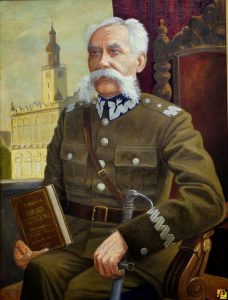
He joined the Polish Army after Poland regained independence in 1918. Józef Piłsudzki charged him with the medical care of the Polish troops during the Bolshevik War in 1920.
Rocky beginnings
The start of his surgical career was as difficult as the fate of the country under the occupants after the Polish partitions. Ludwik Rydygier was born in Dusocin, in a part of Poland under Prussian rule, as one of 13 children. Rydygier got his medical degree in Greifswald and opened his surgical practice in Chełmno. There, he changed his name from German (von) Riediger to Polish Rydygier, which infuriated the Prussian government. Harassed, he moved to Kraków, where the Austrians were much more lenient. From there, he moved to Lwów, where he was asked to lead the surgical faculty in one of the clinics. Jagiellonian University in Kraków and Jan Kazimierz University in Lwów were already counted among the best teaching centers in Europe.
What did it mean to be a pioneer surgeon in 19th century Europe
A surgeon in those days was like Columbus sailing to terra incognita. It was a messy job, full of surprises, and the results of the treatment were terrible. Anesthesia was in its infancy, and a surgeon had to do a quick job while the assistants held the screaming patient. Leg amputation was done in less than 1 minute, and the assistant had to keep his fingers away from the surgeon’s knife. There was no hemostasis and no respect for the patient’s tissues. The wound infections were a paramount problem, and sepsis was the cause of terrifying mortality. But by the end of the century, those problems were mostly solved, and the science and practice of surgery leaped forward.
The path to greatness
Rydygier’s doctoral dissertation was on the use of carbolic acid in the prevention of infection in frogs. To him, the surgeon’s personal hygiene was of the utmost importance. Washing hands, plunging them in the antiseptic solution before the procedure, mouth irrigation, gargling, and hair washing were obligatory. But he did not accept masks, caps, and rubber gloves. He wore a white surgical gown to the procedure, when many surgeons still operated dressed like they were going to a formal dinner reception.

Here is the portrait of Ludwik Rydygier painted by Leon Wyczółkowski:
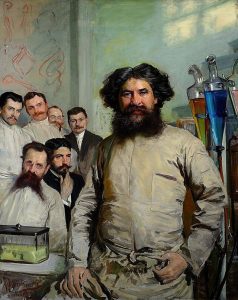
He is portrayed dressed in a white surgical gown, no gloves, no mask, and no surgical cap. Surrounded by his assistants. There are 3 mysterious bottles hanging above his left shoulder. While I could not find the explanation, I suspect there were 3 solutions of chloroform, alcohol, and sulfuric ethyl. A mixture of these he used to drip on the patient’s gauze mask for inhalation anesthesia. Another pioneer achievement.
Why Rydygier could be so much ahead of his peers
It was a combination of the investigative mind, discipline, and persistence. His workday was structured for maximum efficiency. Rydygier’s typical day was described by Prof. Krzysztof Bielecki from Warsaw.
It started at 7 a.m. with doctor’s rounds performed by assistants, followed by duties in the clinic and surgical outpatient clinic; at 8 a.m., Professor Rydygier’s arrival was announced by a doorkeeper with a loud bell. The assistants stopped their work, gathered in his office, and reported on the condition of individual patients. This was followed by the second round with the Professor. After rounds, selected patients were presented at the outpatient clinic. Rydygier lectured to students with illustrations from interesting cases from among his patients. During the lectures he cited Polish authors, promoting at the same time the achievements of Polish doctors. After the lecture, operations began, with surgical procedures observed by the students. Rydygier performed operations slowly but very precisely, taking care of hemostasis. He stressed the significance of anatomy as a basis of good performance. He was not ashamed to refer to an anatomical atlas prior to an operation. When operating, he used a scalpel, not scissors. He used instruments that did not damage tissues. After operating, the staff continued their work in the outpatients’ clinic. Rydygier paid much attention to good practice in the outpatients’ clinic, using his most experienced assistants there.
The careful dissection of the anatomical planes, delicate handling of the tissues, and meticulous hemostasis were the hallmarks of his technique. The era of the fast, sloppy, careless surgeon was over. The effective anesthesia helped, but also the understanding of the importance of inflicting the least possible trauma on his patient. And the discipline to impress this methodology on his coworkers and assistants. When adhering to these principles, his surgical mortality fell significantly.
Rydygier’s views on women in surgery.
“As long as a nightingale sings in Mydlnik and brings food to its female sitting in the nest, I won’t believe in equal rights for women.” Mydlnik was a town on the outskirts of Kraków.
Before we start condemning this giant for his reactionary views, we have to realize 150 years ago the practice of surgery was nothing like we see nowadays. The surgeons in training stayed constantly in the hospital, expected to be present for all the emergencies. Dating was frowned upon, and marriages were strongly discouraged. During my residency at Cincinnati General in the 1970s, I was still putting in 110-hour weeks. Even in the 20th-century hospital powerhouses, women weren’t accepted in surgery, and my mentor, Prof. Jan Nielubowicz, had an opinion that “a woman can be either a woman or a surgeon. Never both.”
Was Rydygier Polish?
You bet he was. His “von Riediger” to the wrath of his Prussian rulers, he changed to “Rydygier.” He published mostly in Polish, lectured in Polish, and was a member of the Polish army. It’s enough to read his autograph under his portrait as a Rector Magnificus at Jan Kazimierz University in Lwów.
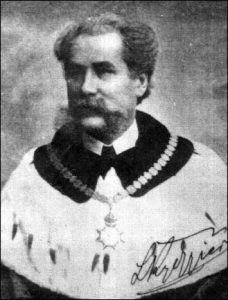
He was as German as Fryderyk Chopin and Maria Curie-Skłodowska were French and Józef Conrad-Korzeniowski was British.
A true national hero.