
The battles for Poland
Poland fought her invaders on the battlefields for centuries. Our young people were savaged by the Germans, Russians, Prussians, Swedes, and Turks, to mention only a few. When not killed, they were used as cheap labor, women were at the mercy of the invading animals, and boys were indoctrinated and trained as a fierce military force. On the higher level, the battles were fought for the minds of the Polish people. The Polish language was banned, and schools were closed, except for the ones producing skilled workers. Many intellectuals, including university professors, were murdered. Polish military officers, most of them highly educated with long traditions of fighting the invaders, were viciously shot by the Russians in revenge after losing the 1920 Soviet invasion.
The Poles fought back and answered with the underground education.
Writes Jan Zaorski:
It should be emphasized that during this time of searching for ways to learn and teach, the teaching staff rose to the challenge. Regardless of their own safety, they organized secret courses or expanded the curriculum in permitted schools to the maximum extent possible.
Underground education started early
The Secret Medical Faculty of the University of Warsaw began teaching in October 1939. The first lecturers included L. Paszkiewicz and W. Orłowski. Lectures were held in students’ homes, high schools, and other venues, while practical classes took place in former universities, private laboratories, and hospitals.
Dr. Jan Zaorski, with his friends, answered the call.
In the fall of 1940, I was approached by recent graduates of secret high schools, who asked me for advice on how to study medicine. They pointed out that secret education had already been organized in some departments of the University and the Polytechnic, so why didn’t the faculty of medicine organize education in the same way? I promised to look into the matter, although I emphasized the considerable difficulties of organizing secret laboratories, workshops, or clinics.
At that time, Professor Franciszek Czubalski approached me and announced that the Faculty of Medicine had passed a resolution authorizing me to organize secret medical teaching. Encouraged in this way from two sides, I decided to take on this task without considering the difficulties and dangers I would encounter. While devising a plan of action, I came to the conclusion that completely secret studies would not solve the problem of the proper medical curriculum. It is impossible to imagine teaching chemistry without a laboratory, normal and pathological histology without microscopy, or physiology without exercises if they are to reach a normal level. Therefore, I decided to organize an open school modeled on other vocational schools.
Zaorski uses the trade school model to build the medical school.
From the Germans, I received the curriculum of the school for medical assistants. The curriculum included numerous subjects, teaching assistants in laboratories, workshops, etc., and auxiliary sciences, in such numerous hours that I realized that our entire medical studies could fit into them. The application was submitted in December 1940. In February 1941, a favorable response was received, so I proceeded to organize the school.
Zaorski underground school of medicine was born.

Dr. Zaorski had a licensed massage school, which he used as a blueprint for the clandestine medical school.

Classes began. Despite requests for secrecy and restraint in sharing information, the young people could not contain their enthusiasm.
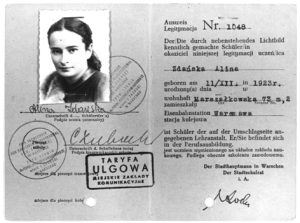
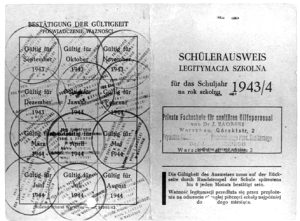
School ID
The necessary equipment had to be found.
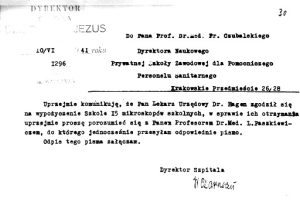
The letter confirms reception of 15 microscopes.
The Germans fight back.
For this reason, among others, the professor was summoned by the Germans to resubmit his plans and scientific programs and warned that he would be held personally responsible if any irregularities were found. They harassed Professor Zaorski often to report on its activities. The situation in the country was very grim. Roundups were regularly organized on the streets of Warsaw.
The School structure
The school had a 2-year curriculum and trained some 1900 young men and women.
With time, however, running the institution was becoming increasingly difficult. Eventually, the school was closed. The lecturers hurriedly took their scientific equipment and secured it in their homes. The fate of the institution seemed sealed. However, the professor did not give up. He reopened the school in the Górski Gymnasium building on Hortensji Street. The institution resumed its activities at full speed, but the pressure from the Germans was even greater.
Ultimately, the professor and his son were arrested by the Gestapo in 1943 and imprisoned in Pawiak. There, they experienced moments of true terror. Many people from the world of science were imprisoned and shot at that time.
Writes Dr. Andrzej Zaorski, the professor’s son.
In 1943, for our underground activity, they took my father and me from our home. First, they took us to Szucha. We sat in the basement in a “tram,” then we had a short interrogation. Then they sent us to Pawiak. At Pawiak, we were first placed in quarantine. Next, the Germans moved us upstairs. My father was taken to the hospital. He was in the hospital not because he was sick, but because he was a surgeon who could help there, and we knew the doctors who were prisoners at Pawiak, for example, Loth, the son of Professor Loth. Loth was also a surgeon. I was left in the cell. They released us after more than two and a half months thanks to my mother’s efforts. In a way unknown to me, she found a way to get someone a prosthetic leg, which he had lost during the war in Poland, and another person received special material [for clothing], and we were released.
The school lasted until 1944, when, expecting the Warsaw Uprising, it was closed. Most of the students and professors participated in fighting, either actively with weapons or delivering care to injured insurgents.
Poland has not yet perished, so long as we still live.
Polish national anthem